

WHY RCEP TYPE AGREEMENTS ARE COMING?
Since the formation (1st January 1995) of the global trade body – World Trade organisation (WTO), there is a continuous stalemate on almost all the issues pertaining to the promotion of world commerce. The member countries are able to finalise only one pact – Trade Facilitation Agreement in goods so far in the history of the WTO.
This has led to frustration among the countries that want to boost their exports for promoting economic growth and create employment for millions of people.
Due to the declining confidence and trust in the WTO’s process, several countries started engaging at bilateral and plurilateral levels.
At bilateral levels, we have dozens of free trade agreements (FTAs) and at a pluri-lateral stage, we are seeing TTP (Trans-Pacific Partnership), TTIP (Transatlantic Trade and Investment Partnership) and RCEP.
RCEP:
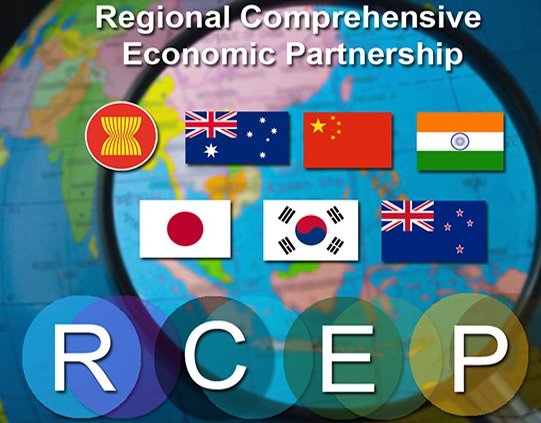
The initiative seeks to create a free-trade bloc in the Asia-Pacific region covering the 10 Asean members (Brunei, Cambodia, Indonesia, Malaysia, Myanmar, Singapore, Thailand, the Philippines, Laos and Vietnam) and India, China, Japan, South Korea, New Zealand and Australia.
AIM AND OBJECTIVES:
The main objective is to promote trade and investments among the member countries besides harmonising procedures and standards. Like any FTA, the RCEP members too want to eliminate or significantly reduce duties or taxes on most of the goods like textiles, chemicals, automobile, agricultural goods and iron and steel traded among the member nations.
Besides, the member countries also want to ease and relax the trading rules for the services sector. This includes easing respective visa rules for smooth movement of professionals. India is very keen on this area.
The 16 countries are also negotiating norms to protect and promote investments of businesses.
HISTORY:
During the 19th ASEAN Summit in November 2011, all the countries including India agreed for RCEP pact.
CURRENT STATUS:
So far 16 rounds of talks have been concluded. The 17th round of talks would start by the end of this month in Kobe, Japan.
Reduction or elimination of duties is one of the main contentious areas of such agreements. Some members including India was of the view that there should be a multi-layer teir system for reduction or elimination of duties, but countries like China and ASEAN strongly opposed to this. SO now, members agreed for a single-tier duty structure.
Under the single-tier system, the RCEP member countries will discuss finalising the maximum number of goods on which duties will either be eliminated or reduced drastically.
On services, the key area of interest for India, there is very less movement.
India is pitching for simultaneous negotiations for liberalisation of trade in goods and services in the RCEP.
Countries like the Philippines are not keen to relax services rules as they are strong in this sector.
In the services sector, mutual recognition agreements (MRAs) are important. But countries take huge time to finalise these.
MRAs pave the way for recognition of the professional body of one country by the other. Regulatory bodies of various professional services like engineering, accountancy and architecture are encouraged to enter into these pacts.
INDIA’S STAND ON REDUCING TAXES IN GOODS:
As India is the largest economy in terms of middle-class population in the group, every country wants this pact to see the day of the light as early as possible.
But India is saying that on this ground it will not be possible for giving equal market access to all the members.
For example, if India would cut duties on 90 per cent of the goods, countries like Australia will get market access for that product in India, whose population is 125 crore. But if Australia would cut duties on 90 per cent of the goods, India would get access to only 23.13 million people market.
CHINA, MAIN CONCERN FOR INDIA:
China always wants to sign a free trade pact with India but Indian businesses always oppose that. Now finally both the countries are part of this mega trade deal. It will be interesting to see as to how India will protect the interest of its domestic players and also give market access to Chinese businessmen.
According to sources, India has not offered any duty cut on steel to China, Australia and New Zealand.
Interestingly India already has FTA with ASEAN, Japan and South Korea and it is negotiating with Australia and New Zealand.
RCEP negotiations started in Phnom Penh on November 2012. The 16 countries account for over a quarter of the world’s economy.
CURRENT STATUS:
So far 27 round of negotiations were held for the agreement. talks are gaining pace as member countries are targeting to conclude the talks by the end of 2019.